

Your leadership team had trust once. Where did it go?
What it costs when trust quietly breaks, and what a leader can do about it.
In brief: Trust in a leadership team rarely breaks in one go. It slips. Something feels off, nobody says it, and someone takes it to a colleague who already agrees. That side chat is the turning point, and it ends in an echo chamber that costs the business in worse decisions, quieter people and lost money. The fix starts with the leader going first.
Right now, one of the world's biggest purpose-driven groups is arguing over who gets the final say. Tata Sons is mostly owned by charitable trusts. This year its board split along the lines of who appointed each director. The chairman was reappointed in September over one director's objection, and the trusts are now talking about taking it to court.
It didn't start there. It never does. It usually starts with something much smaller, like the way I handle feedback.
I have a mild feedback allergy. Symptoms last about two days.
It doesn't matter what the feedback is. It lands, and then I'm back at my desk replaying it in my head, over and over. The only cure I've found is to start working on it. Somewhere in the doing, I go, yeah, okay.
Most of us reach for a different cure. We go to an ally and ask, "Do you think I'm like that?" And they say, "Nah, nah, you're fine."
It feels harmless. It's the same habit that quietly breaks leadership teams. Someone has a problem with a colleague. Instead of telling them, they go to someone they know already feels the same way. Of course that person agrees. Do that enough, and trust breaks. And that costs a lot more than most leaders realise.
How trust slips
Trust rarely breaks in one go. It slips, one avoided conversation at a time.
Nobody takes a seat on a leadership team expecting to distrust the people around them. Co-founders, a new executive hire, a board member in their first meeting. Trust is the starting point, not the goal.
So when a team that was once close begins to feel a bit guarded, it's worth asking what happened.
The six stages
- Trust. Every leadership team begins here.
- Something's off. A person, or the way they work, isn't sitting right.
- Keeping the peace. We say nothing, to keep that fuzzy, lovey feeling. Patrick Lencioni calls it artificial harmony.
- The side chat. We go to someone we trust and start talking about the person instead of to them. And we don't pick just anyone. We pick someone who already sees them the way we do. Maybe they're too much, too blunt, too in your face. Maybe we think they're not up to it. Whatever the reason, the other person agrees, and that's the moment the alliance forms.
- People can feel it. Nobody says anything, but people aren't dumb. And if it's the leader having the side chats, everyone quietly wonders what's being said about them.
- The echo chamber. There's always a pull to surround ourselves with people who agree. Camps form, each one nodding along. Decisions narrow to one person. The boss wins the battle, and the business loses the war.
Up to stage 3, keeping the peace, it's still fixable in one honest chat. Once the side chat starts, it's politics.
Then it feeds itself. The person on the outside gets stonewalled. Shorter answers, fewer invites, emails that sit unanswered. So they get guarded, or they push harder. Either way, it looks like proof that the side chat was right all along.
Researchers have watched this loop for decades. Jean-François Manzoni and Jean-Louis Barsoux called it the set-up-to-fail syndrome. A boss decides someone isn't up to it and starts managing them differently. The person stops volunteering ideas, and the boss sees exactly what they expected to see.
And each time round, it gets harder. The next time there's an elephant in the room, nobody wants to be the one to name it. So the team keeps the peace again, only now with less trust than before.
Are you having the side chat?
Two tests.
You're explaining a problem with someone to a third person on the team, and you haven't said it to them yet.
Or, after feedback, you go looking for "nah, you're fine" rather than for help.
I've done both. Most leaders I know have too.
The side chat doesn't even protect the person having it. In a 2023 study, Greenslade-Yeats and colleagues looked at gossip from the point of view of the person hearing it. When listeners read the gossiper's motives as self-serving, their trust in the gossiper dropped. The person you vent to is quietly asking: what does this person say about me when I'm not in the room?
What does it cost?
None of this stays in the leadership team. Sooner or later it shows up in the numbers.
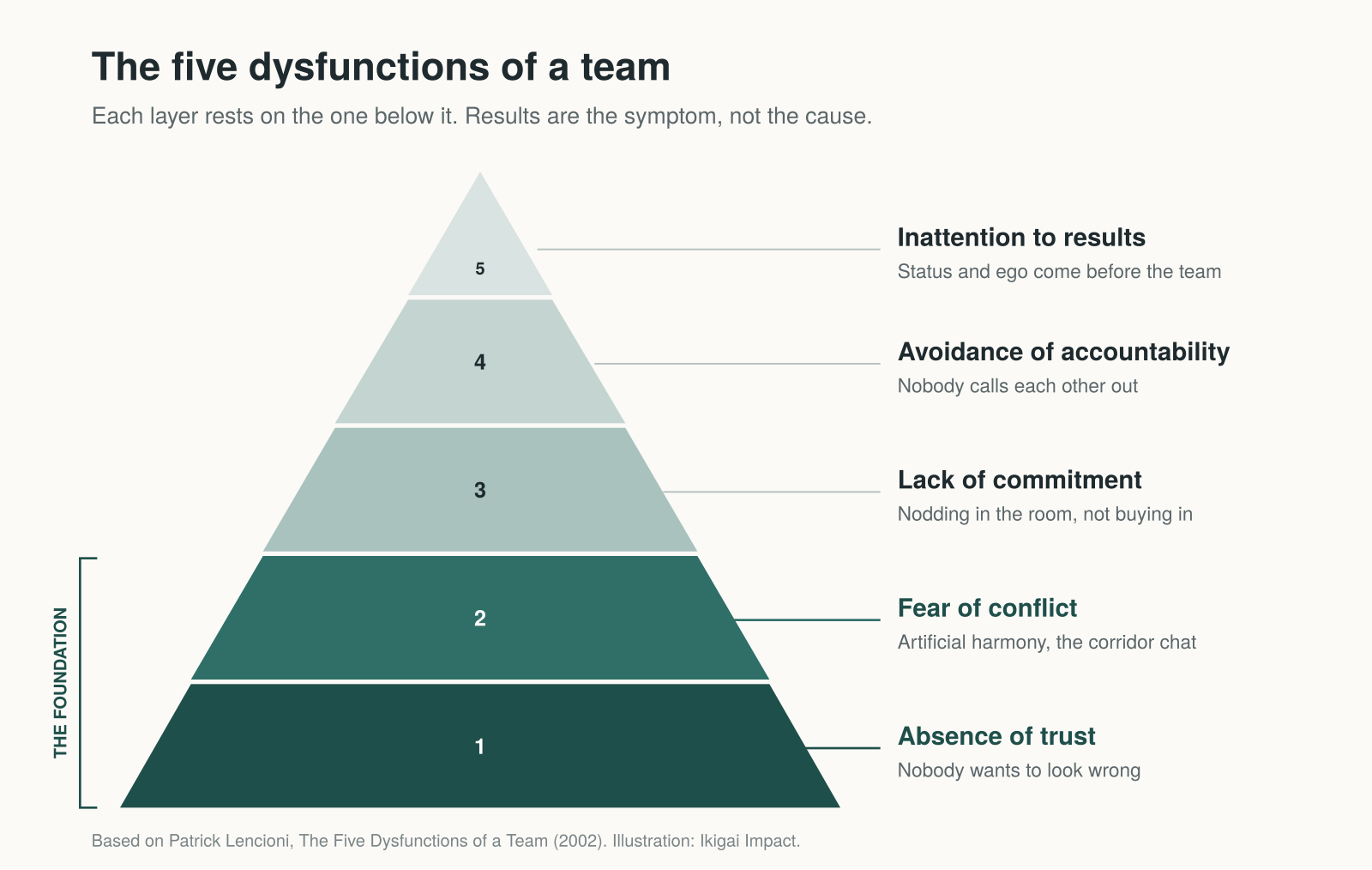
Lencioni's Five Dysfunctions of a Team is built as a pyramid: absence of trust at the bottom, then fear of conflict, then lack of commitment, avoidance of accountability and inattention to results. People sometimes ask me whether the layers are weighted. They are. The bottom two hold up the top three. Poor results are the symptom, not the cause.
The research backs the foundation. Amy Edmondson's 1999 study of 51 work teams found that psychological safety, the belief that it's safe to speak up, was linked to more learning, and learning was linked to performance. When Google studied what made its own teams effective, psychological safety came first. Their test question: if I make a mistake, is it held against me?
So what does it actually cost? It shows up in four places.
The leader's decisions get worse. Park, Westphal and Stern surveyed more than 450 CEOs and over 3,000 of the directors and managers around them. The more flattery and agreement a CEO received, the more overconfident they became, and the less likely they were to change course when the business was struggling. When the business kept underperforming, those CEOs were far more likely to lose their jobs. The echo chamber doesn't protect the boss. It sets them up for a fall.
Good people go quiet. In the set-up-to-fail loop, the person on the outside stops offering ideas and stops asking for help. The strong performers pick up the slack until they're stretched too. You're paying for a whole team and getting part of it.
In November 2026, an independent review of Betsi Cadwaladr University Health Board in north Wales found exactly this. Staff described a "fear of speaking up" and doubted that raising concerns would change anything, while senior managers put targets ahead of the quality of care. In a hospital, that isn't a culture problem. It's a patient problem.
The board stops being a check. In August 2024, Qantas released a governance review covering Alan Joyce's final year as CEO. It described a "command and control" leadership style and a dominant CEO that dampened challenge. The board didn't robustly debate or challenge management. The review found no deliberate wrongdoing. Nobody had to be a villain. A team, and a board, stopped pushing back.
Then it costs money and reputation. The board cut Joyce's pay by $9.26 million. The same year, Qantas paid $120 million to settle the ACCC's ghost flights case, $100 million in penalties and $20 million to customers sold tickets on flights it had already cancelled.
Which leaves the question I keep coming back to. When the side chats take over and the decisions narrow to one person, who does it really serve?
Not the customers. Not the staff. Not the shareholders. Not the community.
We exist to help others, our customers and clients. If we add value to them, then the organisation and our stakeholders benefit. But an echo chamber serves only the person at the centre of it, and usually not even them for long.
What can a leader do?
Go first. You can't ask the team to drop the side conversations while you're still having them.
1. Catch yourself at the corridor. The moment you're about to tell someone on the team about a problem with another teammate, stop and ask: have I said this to them first? If you haven't, that's the conversation to have.
2. Own a mistake out loud. In front of the team, not in a one-on-one. It tells everyone it's safe to be wrong here. A 2023 review of 212 studies found humble leadership lifts the performance of followers and teams. It didn't lift the leader's own. The payoff comes through the team.
3. Go looking for the disagreement. Lencioni calls this mining for conflict. In a meeting, ask "who sees this differently?" and then wait, longer than feels comfortable. Invite the person you know disagrees to speak first.
When someone pushes back, they're not being difficult. They're voicing something, and my job is to pay attention and work out whether they're right or wrong. Even with my feedback allergy.
And on the flip side, if someone always agrees with me, I have to ask myself why. Am I really that perfect?
4. Watch where you go after feedback. I've had my feedback allergy enough times now to know the pattern. When feedback comes, I tell myself: this is going to hurt, but if I work it through and start moving on it, I can test it out for myself. Sometimes it works, sometimes it doesn't. I don't always have the right answer.
Talking it through isn't the problem. It's who you talk to. If you need a sounding board, pick someone outside the team who'll tell you the truth: a coach, a board member, a therapist, a peer group. Not a friend on the team who'll say "nah, you're fine."
This matters more the more senior you get, because the people around you agree with you more. The researchers behind that CEO study had simple advice: get views from people who don't depend on you for their job.
5. Point to the flag, don't micromanage. Be clear about where you're heading, then step back. Clear direction gives people something to debate openly in the room. Without it, they're left guessing what the boss really wants, and that guessing happens in the corridor. A meta-analysis of 116 studies found conflict about relationships hurts teams, while conflict about the task doesn't. A shared goal keeps the argument about how, in the room, rather than about who, in the corridor.
Isn't this just about making everyone feel safe?
No. And this is where I'd push back on how psychological safety sometimes gets used.
A 2023 study by Eldor, Hodor and Cappelli found that routine performance rose with psychological safety only up to a point, and then fell. What offset the drop was collective accountability. The authors were clear it's never OK for people to feel ridiculed or marginalised. But safety without accountability can tip into comfort.
That's the fuzzy, lovey feeling from keeping the peace. It looks like safety. It's actually artificial harmony.
Real safety is being able to say the hard thing to someone's face, and know the relationship will survive it.
So where does that leave us?
The boss can win the battle and the business can still lose the war.
It rarely starts with anything dramatic. It starts with one swallowed comment, and one conversation in the corridor instead of the room.
I still have my feedback allergy. Some weeks it lasts two days, some weeks longer. But I've learned to notice the moment I reach for an ally who'll tell me I'm fine, and start working on it instead.
So here's my question for you.
When did you last go to the corridor instead of the conversation?
In short
- Trust doesn't break in one go. It slips. Something's off, we keep the peace, the side chat starts, people feel it, and the echo chamber forms.
- The side chat is the turning point. We talk about someone, to someone who already agrees, and the alliance forms.
- Trust and healthy conflict hold up everything else. Poor results are the symptom, not the cause.
- The cost is real. Worse decisions at the top, good people going quiet, a board that stops pushing back, and eventually the money and the reputation.
- The leader goes first. Say it to their face, own mistakes in public, invite genuine dissent, and choose an honest sounding board over a friendly one.
- Safety isn't comfort. Psychological safety works best alongside accountability.
Benn Lim is a Scaling Up coach working with CEOs of purpose-driven organisations across Australia to find the cash, bring their team with them and stop running on empty.
Want an honest outside view of your leadership team?
Part of my work with CEOs is being the sounding board outside the business who'll tell you the truth, not just that you're fine. If something's off in your team and nobody's naming it, I'm happy to talk.
Book a discovery callNot ready to talk yet?
Get new articles on cash, people and purpose-driven leadership in your inbox when they're published.
About once a month. Unsubscribe any time.
Sources
- Australian Competition and Consumer Commission (2024). Federal Court orders Qantas to pay $100m in penalties for misleading consumers.
- Australian Institute of Company Directors (2024). Insights from the Qantas governance review.
- ch-aviation (2024). Qantas board hits ex-CEO Joyce with AUD9.26mn pay cut.
- Chandler, J. A., Johnson, N. E., Jordan, S. L., et al. (2023). A meta-analysis of humble leadership. The Leadership Quarterly.
- de Wit, F. R. C., Greer, L. L., and Jehn, K. A. (2012). The paradox of intragroup conflict: A meta-analysis. Journal of Applied Psychology.
- Edmondson, A. (1999). Psychological safety and learning behavior in work teams. Administrative Science Quarterly.
- Eldor, L., Hodor, M., and Cappelli, P. (2023). The limits of psychological safety: Nonlinear relationships with performance. Organizational Behavior and Human Decision Processes.
- Google re:Work. Guide: Understand team effectiveness.
- Greenslade-Yeats, J., Cooper Thomas, H., Morrison, R., and Corner, P. D. (2023). How workplace gossip shapes interpersonal relationships. Group and Organization Management.
- ITV News (2026). 'Immature' leadership and 'toxic' culture at Betsi Cadwaladr health board, review warns.
- Kellogg Insight (2012). Flattery's dark side.
- Manzoni, J.-F., and Barsoux, J.-L. (1998). The set-up-to-fail syndrome. Harvard Business Review.
- Park, S. H., Westphal, J. D., and Stern, I. (2011). Set up for a fall: The insidious effects of flattery and opinion conformity toward corporate leaders. Administrative Science Quarterly.
- The People's Board (2026). Stakeholders vs boards: What Tata Sons and Nvidia reveal about leadership disputes.
- Edmondson, A. C. (2018). The Fearless Organization. Wiley.
- Lencioni, P. (2002). The Five Dysfunctions of a Team: A Leadership Fable. Jossey-Bass.
- Nemeth, C. (2018). In Defense of Troublemakers: The Power of Dissent in Life and Business. Basic Books.
